

By Todd Slaughter
Available now from Amazon. Or click on image for a signed copy.
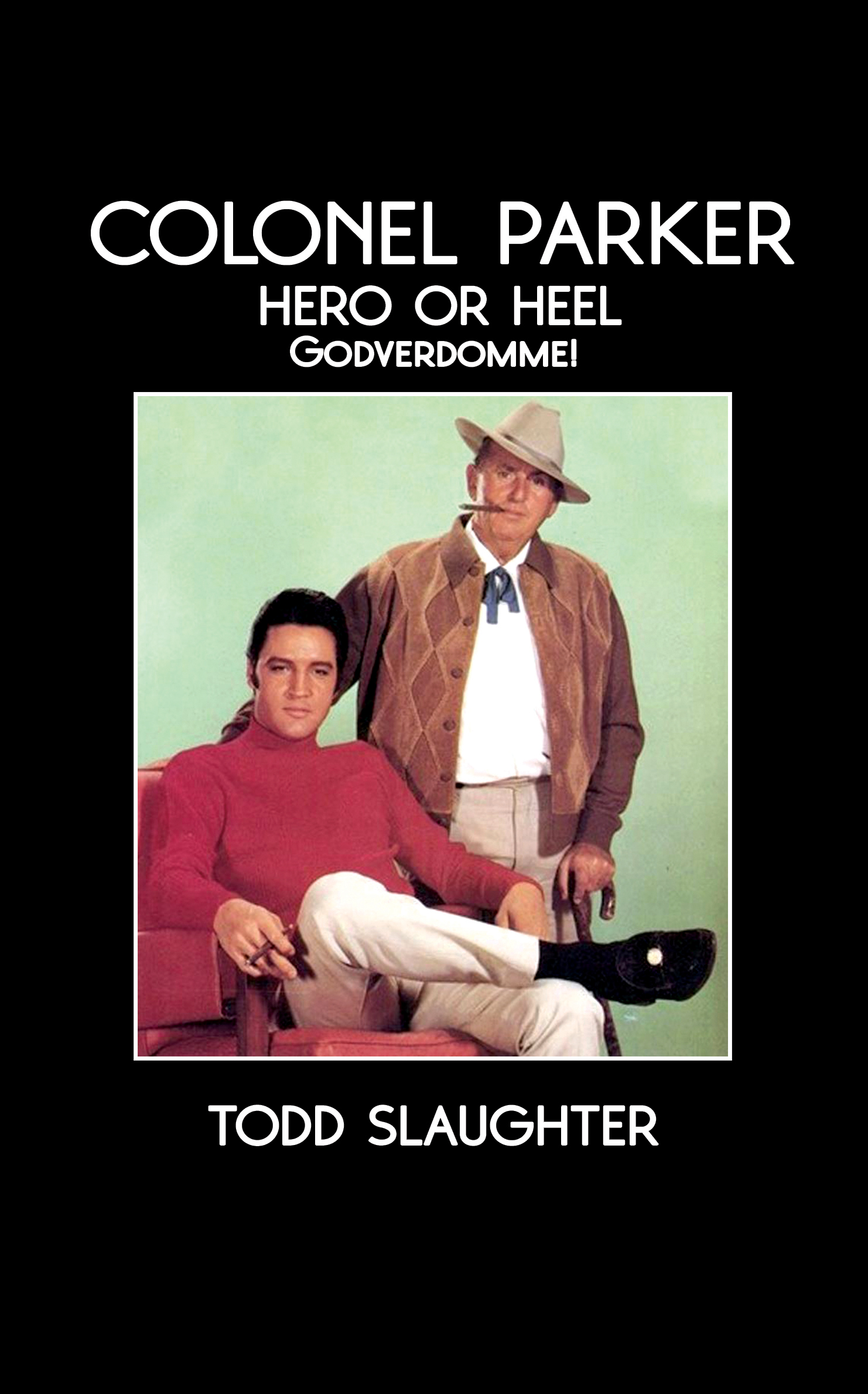
Subtitled “Godverdomme1! (Dutch wording For God’s Sake!”) is not a biography but an overview of the private and commercial life of one of the world’s most famous, some may say infamous, showbusiness managers. Being the boss of a business, a football team or an entertainer attracts a variety of praise and abuse, and, since Elvis’ death, Colonel Parker has been vilified from all quarters.
I was battered and bruised when Elvis died. He was my hero, the voice I turned to when I needed solace, the man who spearheaded my social existence and enabled me to cultivate lifelong friendships with like-minded souls. It would be wrong of me to say that Elvis knew me, but he was aware of what I did, and that was a thrill. On several occasions, he acknowledged me and our party of Fan Club members from the stage when we were in his audience. How good is that?!
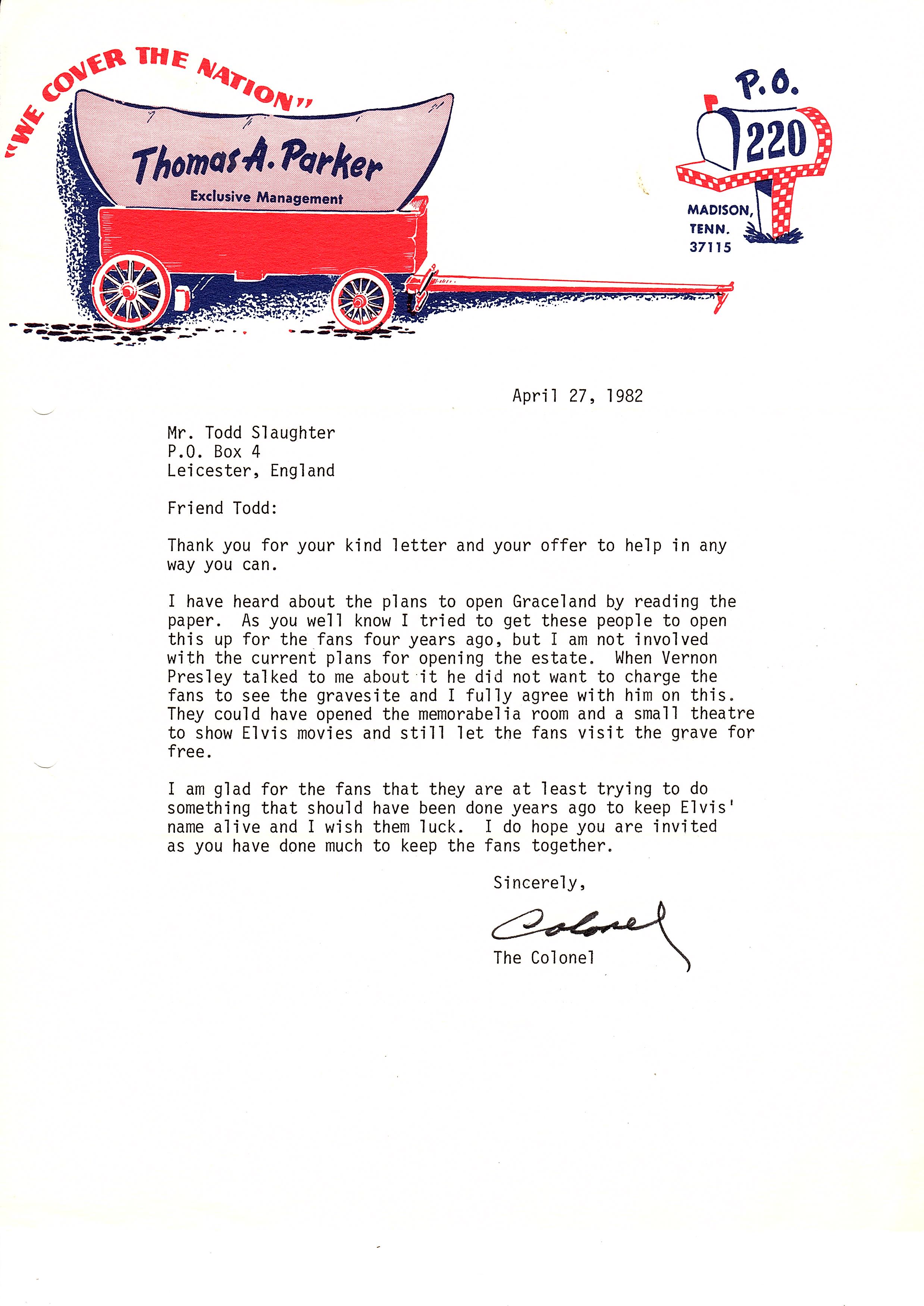
Colonel Parker knew me, helped me, was kind to me and my family, particularly during some difficult times, especially when I had a heart-transplant almost 27 years ago. He was my friend, but that does not exonerate him from the mistakes he made when looking after Elvis’ interests. All that said, I want Colonel Parker to be remembered as Elvis’ manager, and not mistakenly as the guy who invented Southern Fried Chicken.
Why a book on the Colonel? I’ve often been asked why I have never tackled a life story on Elvis Presley having been associated with his Fan Club for almost sixty years. Most journalists and academics, who have told the “Elvis from a shed to a castle story”, have done so by researching other authors’ works, but the “he-said she-said” tales are either discounted or embellished. Although I met Elvis three times, and he acknowledged my presence in his audience several times, I couldn’t say that I knew Elvis so why pretend that I did, but, for part of his life, I did know Colonel Parker. In “Hero or Heel” I recount the many stories he told me about his early life and personal revelations that he shared with me.
There are certain things that Colonel arranged for Elvis which were detrimental to Elvis’ career. There were business dealings that no doubt favoured the Colonel’s bank balance and, on the surface, could be and were judged to be not to Elvis’ advantage.
In the UK during the late 1950s and early 1960s the British music industry, anxious to share in the successes of Elvis Presley, Bill Haley and Johnnie Ray, created its own cluster of domestic pop acts. Tommy Steele, Marty Wilde, Billy Fury and Cliff Richard were initially mirror-images of the American style of performer. With American TV showcases of US artists not screened in the UK due to product placement advertising, pop fans had to reply on Radio Luxembourg to launch new talent.
UK Fans hungry to see and hear our British stars spent as much as they could afford. Money poured in from concert tours, cinema ticket sales, record royalties, TV and radio show fees. But overall, however, income didn’t get further than the bank accounts of managers and promoters. Chart topping acts were paid “wages”. While Colonel Parker was negotiating deals for Elvis to receive $10,000 a week, Billy Fury was getting £30.00 from his manager, Larry Parnes.
Most American people would not identify the Dutch language, so they can be excused into thinking that its guttural throaty sound could be confused as being German. Many of the people who worked for Elvis thought that Colonel’s twang indicated a Germanic ancestry. Those early immigrants settled in Pennsylvania, and fifty million Americans today can trace their families to German stock. German Americans are the largest of the self-reported ancestry groups by the United States.
Parker’s brother, Ad van Kuijk, visited him in Los Angeles in 1961 and was introduced by the Colonel to Elvis as being his brother. Surprisingly, the story was not picked up by the American press until after Elvis’ death, although Dutch fans travelling with us to see Elvis in Vegas in 1972 spoke to Parker in their native tongue.
Parker’s vocabulary was confusing at the best of times. He spoke Brabantian, a colloquial Dutch language used by a quarter of the population of Holland, which he embellished with bits of German, a little Yiddish, some French and Cant, an American version of Parlyaree; a fairground workers secret language, understandable by no one other than fellow carnies. On one occasion, he spoke to me in Cant, an undiscernible gobbledygook of noises and perfunctory mannerisms. He roared with laughter after delivering a diatribe of what appeared to me to be a bunch of verbal nonsense.
The previously published routes taken by sea, enabling Colonel Parker, then Andreas van Kuijk, to reach North America are fanciful. There is no way this dapper young man would have travelled across the Atlantic Ocean, holed up in rat infested bilges of freighters, heading towards the Dutch Caribbean Island territories of Aruba, Curaçao and Sint Maarten. Getting from these islands into the USA would have been more difficult than jumping ship in New Orleans. And he didn’t do the latter either.
Having read many books on the young Andreas, the often used “it is assumed that” or “the most likely”, when translated into author-speak means, “not having a clue”.
The tales I tell came from the mouth of Colonel Parker. There is no way that I can guarantee that he wasn’t selling me a “crock of s**t”, but his explanations were more believable than the imaginations of others.
Almost hidden amongst a collection of cut-glass elephants in a variety of sizes was a picture postcard of a ship, also encrusted in a cut glass frame. The desert sun burning through the window illuminated the exotic creatures, producing shards of different coloured light across the lounge. 2000 Plaza de Santa Fe was the Las Vegas home of Colonel and “Mrs Colonel”.
The RMS Carinthia was a British vessel built in the Barrow-in-Furness shipyards by Vickers Armstrong in 1924. The prefix RMS denotes its class as a passenger carrier and a Royal Mail Ship contracted to the British Post Office to export and import overseas letters and parcels. (HMS is His or Her Majesty’s Ship belonging to our Royal Navy.)
Andreas van Kuijk aka Dries was born in Breda, Holland on 26th June 1909. As he became a young lad, he was the centre of attention within the family unit. His siblings adored his antics and encouraged their friends to pay a few Guilder cent coins to listen to his story-telling, watch his performances and muse at his clowning. Sadly, he was also centre of attention for a perverse family relative who subjected Dries to frequent serious sexual assaults. By the age of seven he would disappear for days on end to avoid being abused. Unwilling to burden his parents with the horror of the depravity he was experiencing, he sought sanctuary with his maternal grandfather, Johannas Ponsie. Mr Ponsie’s advice to young Dries was simple. “When you can, run away boy. There’s a whole world out there into which you can disappear.” Ponsie Snr died three days after his grandson’s eighth birthday. During the intervening years, until Dries judged himself as a young man, he would attend school from time to time, but when the circus came to town he would vanish. Casual work on fairground side shows, even for a curly-headed ten year old who would easily pass for an early teenager, was easy to come by.
Realising that something was wrong, Dries’ father, Adam, agreed to allow his son, once becoming fourteen, to leave home and move to Rotterdam. He lived with his uncle, Jan Ponsie, and his wife. He kept himself to himself, was made their responsibility legally in January 1926 and as he now had a guardian, the young man decided to sever his ties with Breda. In the evening he was a stay-at-homer, reading a little and listening to the family crystal set. He was captivated with the radio transmissions he received through the equipment headphones, not only from across Europe but from the Americas. It was across the Atlantic that he wanted to be, and his love of radio which he saw as a mass influencer, was to become the key to unlock his future successes.
In May 1929 it was time to jump aboard a cheesy laden freighter and head westward for pastures new. It wasn’t the first time the young Dutch lad had travelled to England with Edam and Gouda. The destination could have been either Harwich in Essex or Felixstowe in Suffolk. This time it was Harwich and, after an over-night stay in the local Seafarers Mission in Dovercourt, he was given a change of clothes, a Holy Bible and a florin (two shillings.) “I always carried a bible, but I left my confirmation text in Rotterdam. It was this book and the passages that I knew off-by-heart in Dutch, that helped me with learning more than a smattering of English which I had previously picked up from sailors and traders. As you know, I have a good memory, I never forget anything!” He told me, “And oh yes, they gave me some bread and cold fish for my journey. I knew a Dutch family in Bedford, and I lived with them, working as a labourer in a truck factory for three months, before heading north to Liverpool”.
Colonel explained that he departed his “digs” at the Adelphi Hotel and worked his passage as a waiter in the William of Orange Suite on the Carinthia, in the summer of 1929, on a sailing from Liverpool to New York. He left the ship in Boston, as the Royal Mail was unloaded, avoiding immigration checks in New York. “Did I know”, he asked, “that the Carinthia was sunk by a German torpedo in 1940? Anyway, how is my ship?” Parker was an investor in the Dutch pirate radio station, Radio Veronica, through his good friend and fellow “illegal immigrant” journalist and broadcaster, Jan Storm.
By October 1929, Thomas Parker had travelled to Atlanta, Georgia and enlisted in the US Army at the Fort McPherson Military Base. This was a wise move as the “Great Depression” had just started and unemployment in the State was rife. The unstable American economy throughout most of the 1920s, and the Wall Street Crash in 1929, led to an unprecedented depression in the USA. Big companies and banks collapsed. The crash brought financial ruin for many businessmen and financiers. America’s GNP dropped by almost fifty per cent. To sustain the local unemployed, Robert Winship Woodruff, the boss of the Atlanta based Coca Cola company, donated $5,000,000 to Lamartine Griffin Hardman, the democratic Governor of Georgia. Parker knew he had made the right move and an immediate posting to Hawaii was a gift.
Much is made of the fact that Thomas Parker was an illegal immigrant, but, in the 1920s, fifteen per cent of the population were not registered and could have been classed as “illegals”. Anglo-Saxon migrants were welcomed and offered IRS registration affording them the right to stay in the country. Parker, now being an employee of the US Government, was as legal as he needed to be. Having $5.00 a month of his pay transferred to his mother by the US Army to a representative bank in Breda, confirmed to the military that he was a Dutchman.
Tom Parker had an uneventful two years in the 64th Coastal Artillery Brigade, an anti-aircraft unit stationed at Fort Shafter, close to Honolulu. Colonel told me that whist in Hawaii he and a fellow squaddie who had family in Brisbane, Queensland, planned to travel one day together to Australia. The Colonel said to me that he eventually went to Brisbane in 1934 with his Army chum, which was well prior to managing Elvis and his other country music stars. After two years in Hawaii, Parker was transferred to Florida, before being hospitalised in Washington, following a series of severe anxiety attacks, and subsequently honourably discharged in August 1933.
With $133 Army Severance Pay in his pocket, Thomas Andrew Parker wasn’t about to hang around in President Roosevelt’s capital. He bought a $3 Greyhound Bus ticket to Tampa in Florida to join the circus. He knew that the major touring carnivals would “winter” in Florida from September onwards, be ensured of good weather and a huge contingent of wealthy “snowbirds” who would be leaving the northern states to stay warm from October onwards.
Although his own carnival experiences were nurtured and honed in Holland when he was a kid, he knew all the tricks, scams and fiddles and that they wouldn’t be too different from what he learnt from the travelling entertainers in Europe. Carnival and circus people were the same the world-over, talented misfits who fed on the applause of an audience. He got enough carny work to keep himself solvent but was never considered adequate to be a promotions manager, mainly because of his peculiar accent. He was hungry to promote because he could identify where those appointed to the task had not got the chutzpah to make it happen. Those who eventually supported him, he would cherish, assist them in hard times as they had helped him, and befriend them for the rest of their lives. When touring with Elvis, if he heard that there was a circus in town, he would spend time with his old carnival pals.
After his Australian adventure, he spied his chance of a relationship with a “carnival queen”. When a fiery, hot carny babe by the name of Marie Mott divorced her previous husband in March 1936, Thomas Parker made plans to marry this captivating wild woman. A religious man, Parker was vehemently opposed to couples living together out of wedlock. (In later years he was not happy when Elvis “lived over the brush” with Priscilla – the young girl that he enticed to leave her army family in Germany and squirrelled away under the cover of darkness into Graceland.)
His acts of kindness to those who helped him when he was living on the bones of his arse, have mostly been ignored. Clyde Rinaldi, a Tampa-based printer, extended a line of credit of $5, which was a tidy sum to risk during the depression. His generosity enabled Parker to have some promotional tickets printed. In later years he would reward Clyde’s trust by insisting that RCA place all of their Elvis related printing with his little business. He made Mr Rinaldi an extraordinarily rich man. After departing his carnival capers, Mr and Mrs Parker took care of the Tampa Humane Society. This sanctuary for unwanted cats and dogs, which they tried to rehome, survived on public donations - a practice that Parker was adept at with press stories and publicity stunts to attract willing givers. He also opened what is believed to be the world’s first pet cemetery whilst at the same time being a press and publicity agent for a variety of travelling carnival and circus operators. An event in Tampa during the winter of 1943, when a film unit man approached the Humane Society with a request to “borrow” a few moggies and pooches, inspired him greatly. MGM were making a WWII movie “A Guy Named Joe” starring Spencer Tracy as an angel with Van Johnson playing the part of Joe, a lonely GI. Directed by Victor Fleming, Parker was so exhilarated with the production that he schmoozed him. He had caught the show business bug and knew he needed that Hollywood director’s name in his address book.
As early as 1939, when Britain declared war on Germany, promoter Parker had become involved in booking acts for tent shows around Florida and managed to attract Gene Austin for Hoxie Tucker known as the “Canvas Carny”. Austin had been a heartthrob throughout the 1920s selling almost 100 million recordings before being succeeded by Bing Crosby who was a screen idol as well as a classic crooner with global appeal.
By 1942 WWII was starting to impact on normal life in the deep south of the USA. Parker was getting more involved in the world of country music and its expansion across all the Southern States primarily due to the success of the Grand Ole Opry WSM radio show. He was fascinated in the promotional power of radio and always kept disc jockeys in the loop with what he was doing. He had great respect for these guys, and they hung onto his every word absorbing tales of his carny days.
Because of war shortages, rationing was introduced especially with vehicle tyres and gasoline. It was becoming virtually impossible for folks to travel across country to see their music favourites, so Tom Parker thought it easy to bring the stars to their towns, playing in fields from the back of flat-bed trucks. Feisty comedienne Minnie Pearl and Eddy Arnold were favourites of the time. In 1945, Parker would become Arnold’s manager. Three years later, Governor Jimmie Davis, a former country act, gave Tom the honorary title of Colonel in return for the promotional work that he performed for Davis’s election campaign. After this anointment, from then onwards everyone was instructed to address Parker as “Colonel”.
Anxious to launch his own star, Colonel feted fifteen year old singer Tommy Sands, promoting his appearances and introducing him to RCA’s Steve Sholes. By 1953, Eddy Arnold sacked Colonel because of his efforts in helping singer Hank Snow. He agreed a management contract buyout with Arnold paying Parker the equivalent of half a million dollars, giving the Colonel to opportunity to launch Jamboree Attractions, a promotional company set up for up-and-coming country singers. Two years later, Parker’s second-in-command, Tom Diskin, alerted him to the rising presence of a young Memphis based performer with the unusual name of Elvis Aron Presley, and at 3.30pm on 21st November 1955, a basic management contract between Elvis and Colonel Parker was agreed. The resat, as they say is history.
It's a fact that Parker never officially acquired U.S. citizenship. That is nothing unusual or even unlawful; a person can reside legally in a foreign country without being its citizen.
We know how and when Andreas van Kuijk got himself a new name because his awkward name 'van Kuijk' wouldn't have been too helpful in an English-speaking country. In the UK our showbusiness moguls who came from Eastern Europe adopted a variety of imaginative surnames: Barron, King, Prince, Delfont, Grade, Grace, Wise, Black, Blue, Green, Gold, Silver and Diamond.
I know after talking with Colonel and Mrs Colonel that there were emotional reasons why he didn’t want to re-visit Europe. There might have been various reasons why Elvis never toured the world, but Parker's allegedly non-existent passport was certainly not one of them.In1957 the Colonel escorted Elvis to concerts in Canada, and also in the same year, he went to Hawaii with Elvis which back then wasn't a state of the US. The Hawaiian Islands didn’t become the 50th state of the USA until 21st August 1959, and he also visited Australia in 1930s
Colonel Parker loved telling stories from his time at the carnival. But the oft told tale about dancing chickens on the hotplates, I know that the story wasn’t true. Colonel loved animals (sometimes more than he liked people) especially big animals such as elephants - they fascinated him. As a student in Holland, he spent all his spare time at the carnival and dabbled in training animals. In Tampa he directed a municipal animal home where he took care of abandoned and abused animals; he even installed a pet cemetery. And he made good money with it but that didn’t make him an animal abuser.
Long before taking over Elvis' management, Parker was already a highly successful artist manager and tour organizer for – among others – country music top acts Eddy Arnold and Hank Snow. By the time Elvis and The Colonel met, Parker was already a millionaire being skilled, prosperous, influential man in show business, while Elvis was still playing small venues. Elvis already had two managers before Parker, Scotty Moore and Bob Neal. Neither could provide him with either a contract with a major record label, nor a national (let alone international) hit, nor lucrative performances, nor exposure on television. Certainly, another manager could have made Elvis successful. Not just any other, but only a good one.
Colonel Tom Parker himself once said, in an interview in his later years, that Elvis had such an incredible talent that anyone could have made him a star. This was, for sure, nothing but an understatement to keep the focus on Elvis instead of the man behind him. He believed so steadfastly in Elvis that at the end of 1955, he ended his extremely lucrative cooperation with country music superstar Hank Snow and others, risking everything from then on by giving his undivided attention to Elvis, virtually starting from scratch.
Elvis got the best deals because Colonel negotiated the best contracts for him. Not until everything was exploited to Elvis' advantage, was the deal good enough. This made Elvis one of the few artists who enjoyed full artistic freedom in his recording contract and from the very beginning of their relationship. Most other stars could – then and now – only dream of achieving such global and financial successes. Ask yourself, why are there so many Elvis Tribute Acts today? Colonel made Elvis a phenomenal brand. He was only able to do this because Colonel realised that Elvis was such an incredible talent from the get-go.
Colonel Parker wasn't Elvis' surrogate father, nor his pastor, nor his therapist, nor his musical consultant. Elvis had more than enough people around him to fulfil those needs. Colonel Parker was the business manager of Elvis Presley; his only job was to get the highest amount of money possible out of whatever Elvis did artistically. That is exactly what he did, but, on occasions, we all know, after reading about his deals with Elvis, eventually the divided the booty 50/50. Though according to his second wife Loanne Parker he never took more than 30% of his concert and recording incomes.
I have tried to accurately document the stories that Colonel Parker and his wife told me in their later years. Likewise the documented facts of the deals that Colonel did with Elvis and his family, Sun Records, RCA, Paramount, 20th Century Fox, United Artists, Allied Artists, MGM, Warner Brothers, Universal, CBS, ABC, NBC, and Factors Etc Inc., are here to be seen.
There were a number of attempts for Elvis to perform in the UK. One of the best deals was for Elvis to appear at what was Windsor Safari Park (now Legoland). MGM would film the concert for the proposed MGM movie “Elvis On Tour 2” and there were negotiations between the Billy Smart Organisation. The Smart family were friends with Parker as they had a mutual interest in the Circus and Carnival World
SHOULD ELVIS HAVE DUMPED COLONEL? My Conclusions
I believe that no one could have done better for Elvis from 1956 up to 1973. The Colonel had some clever tricks up his sleeve – promotional skills that no other manager had tried before, and they were unique. The post army movies were at that time what the cinema audiences and the fans wanted to see – they encapsulated that time frame. But after 1963, especially when the Brits were dominating global record sales, Elvis became despondent feeling trapped in Hollywood. Then there was that epiphany moment, with Elvis in command of his audiences, when he returned to live entertainment. However, within four years, he was trapped again, and sadly Elvis wasn’t the type of guy to argue with the man who was still bringing in millions of dollars. Elvis often complained to his family, friends and even from his stage to his fans, about having to do things he didn’t want to do. With hindsight Elvis should have quit touring at the end of 1973 and taken time off to deal with his health issues and his demons. If he judged Colonel to be one of those demons, then he should have parted company with him. He could have chosen to host his own television series, concentrated on his wish to be a serious actor and, when the time was right for Elvis. to make those personal appearances overseas. Had there been a drastic change in direction, then I believe that Elvis could have been alive today.